
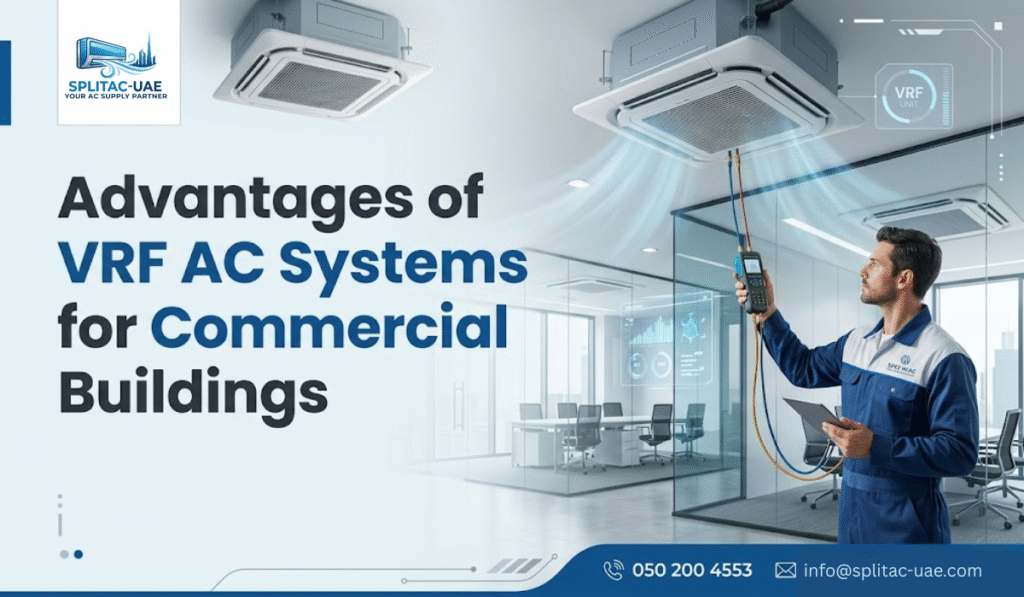
Modern commercial buildings demand air conditioning systems that are flexible, energy efficient, and capable of handling different cooling requirements across multiple zones. Traditional HVAC systems often struggle with uneven cooling, high energy consumption, and limited control over individual spaces. This is where VRF (Variable Refrigerant Flow) air conditioning systems have become a preferred solution for commercial properties in the UAE and globally. VRF technology offers advanced temperature control, improved energy efficiency, and scalable installation options that make it ideal for offices, hotels, retail centers, and large commercial complexes. Unlike conventional systems, VRF AC systems can simultaneously cool different areas of a building at different temperatures, making them highly efficient and adaptable for modern commercial environments.
A VRF air conditioning system is an advanced HVAC technology that controls the amount of refrigerant flowing to multiple indoor units based on real-time cooling demand. This means each zone or room receives exactly the amount of cooling it needs without wasting energy.
The system consists of:
• One or more outdoor units
• Multiple indoor units
• Refrigerant piping network
• Intelligent control system
VRF systems are designed to provide precise temperature control, making them highly suitable for buildings with varying occupancy levels and usage patterns.
Commercial buildings require HVAC systems that can operate efficiently under constant usage while maintaining comfort across different zones.
One of the most important advantages of VRF systems is zoned temperature control. Each room or section of a building can have independent temperature settings based on usage and occupancy.
This is especially useful for:
• Office departments
• Hotel rooms
• Retail sections
• Meeting rooms
• Conference halls
VRF systems only use the amount of energy required to maintain desired temperatures. Unlike traditional systems that operate at full capacity regardless of demand, VRF technology adjusts refrigerant flow dynamically.
This results in:
• Lower electricity consumption
• Reduced operational costs
• Improved energy performance ratings
VRF systems allow long piping distances and flexible indoor unit placement. This makes them suitable for complex building layouts where traditional ducted systems may not be practical.
Benefits include:
• Easier system expansion
• Suitable for multi floor buildings
• Minimal structural modifications required
Most VRF indoor units operate at very low noise levels, making them ideal for environments where silence and comfort are important.
This includes:
• Corporate offices
• Hotels
• Hospitals
• Libraries
• Luxury retail spaces
Some advanced VRF systems can provide heating in one zone while cooling another at the same time. This is highly beneficial in large commercial buildings with different thermal requirements.
VRF air conditioning systems are designed with intelligent compressors and control mechanisms that continuously adjust refrigerant flow based on real time demand.
This improves:
• Temperature accuracy
• System responsiveness
• Overall HVAC efficiency
• Indoor comfort consistency
Unlike traditional systems that switch on and off frequently, VRF systems operate smoothly and maintain stable performance.
Energy efficiency is one of the strongest reasons why commercial buildings are shifting toward VRF systems.
Since VRF systems only deliver required cooling, they eliminate unnecessary energy usage during low demand periods.
The system distributes cooling intelligently across different zones, ensuring balanced energy usage.
VRF systems reduce peak electricity demand, which can significantly lower utility costs for large buildings.
VRF HVAC systems are widely used across various commercial sectors due to their flexibility and efficiency.
They are commonly installed in:
• Corporate office buildings
• Shopping malls
• Hotels and resorts
• Hospitals and healthcare facilities
• Educational institutions
• Mixed use developments
Each environment benefits from independent temperature control and energy optimized performance.
Compared to conventional systems, VRF technology offers several advantages.
Traditional systems cool entire zones uniformly, while VRF allows precise control per room.
VRF systems adjust output dynamically, unlike fixed speed HVAC systems.
VRF systems require less ductwork and can be adapted to complex layouts.
Energy savings and reduced maintenance requirements make VRF systems more cost effective over time.
Although VRF systems are highly efficient, regular maintenance is essential for long term performance.
Key maintenance tasks include:
• Refrigerant pressure checks
• Filter cleaning
• Electrical system inspection
• Indoor unit servicing
• Outdoor unit maintenance
Proper maintenance ensures consistent cooling performance and extends system lifespan.
While VRF systems offer many benefits, installation requires technical expertise and precise planning.
Common challenges include:
• Complex design requirements
• High initial installation planning
• Need for skilled HVAC technicians
• Proper refrigerant balancing across zones
Professional installation is critical to ensure system efficiency and reliability.
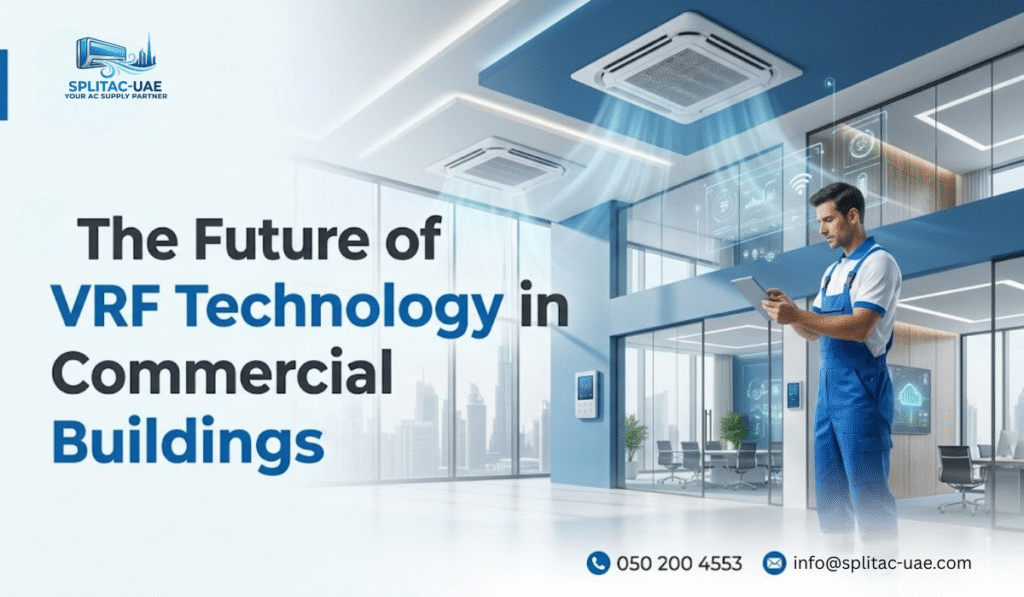
VRF systems are becoming increasingly popular in modern construction due to their energy efficiency and smart control capabilities. As commercial buildings focus more on sustainability and operational cost reduction, VRF HVAC systems are expected to become a standard solution.
Integration with smart building systems and IoT based climate control is further enhancing their efficiency and usability.
Splitac-UAE provides advanced AC solutions including VRF air conditioning systems designed for commercial buildings across the UAE. With a focus on energy efficiency, system reliability, and professional installation, Splitac-UAE delivers cooling solutions tailored to modern building requirements.
From offices and retail spaces to hotels and large developments, VRF systems supplied and installed by Splitac-UAE ensure stable performance, optimized energy usage, and long term comfort in demanding climate conditions.
VRF air conditioning systems offer a modern and highly efficient solution for commercial buildings that require flexible cooling, energy savings, and precise temperature control. Their ability to manage multiple zones independently makes them far superior to many traditional HVAC systems in large scale environments.
Although the initial investment and installation require expert planning, the long term benefits in energy savings, comfort, and system performance make VRF technology a valuable choice for commercial properties.